Move Slow and Fix Things
THE SPEED TRAP
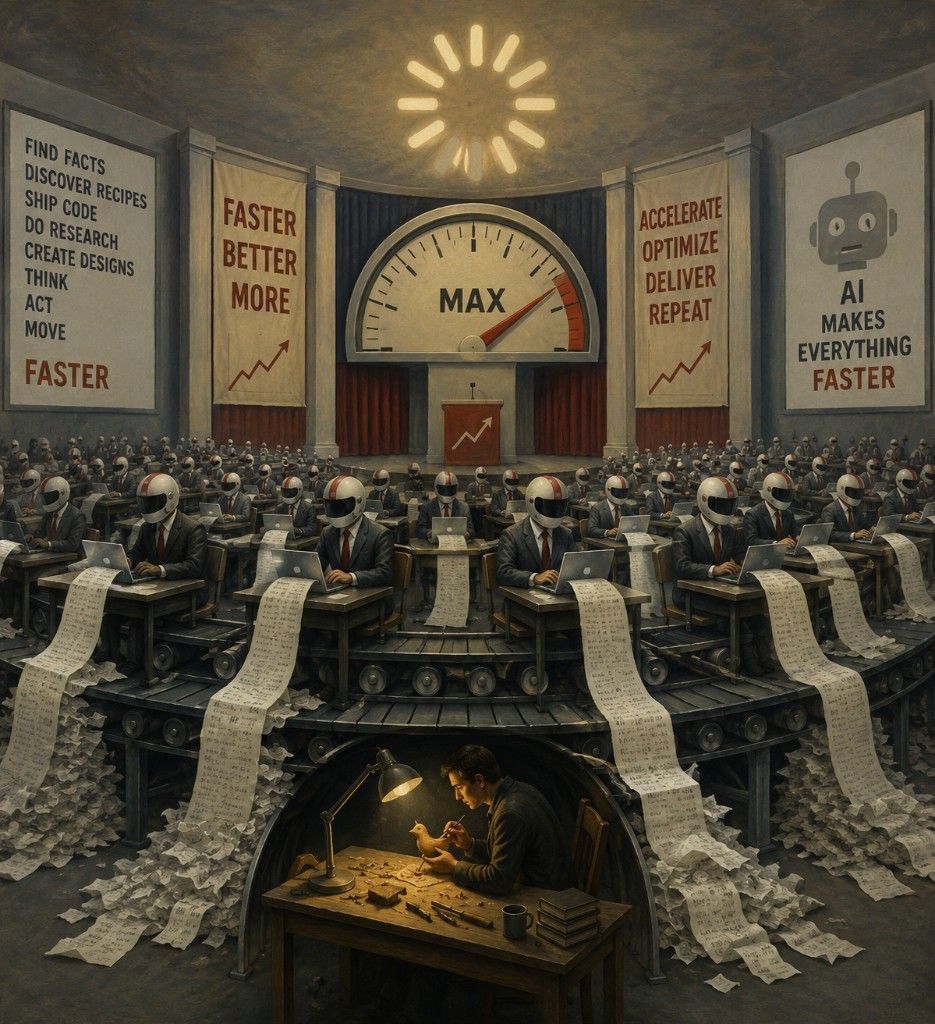
I'm not sure if you've noticed, but AI apparently makes everything faster.
Find facts faster.
Discover recipes faster.
Ship code faster.
Do research faster.
Create designs faster.
Think faster.
Act faster.
Move faster.
I don't think that AI is making most people faster at anything other than shipping absolute AI Slop. For most people AI is simply a way to get through work and move on to the next thing. Their work is a mile wide and an inch deep. And it's not just individuals at fault here, I'd argue that it's organisations that are create this mass speed theatre masquerading as progress.
I'm seeing this trend in businesses of all sizes, organisations struggling to keep up and individuals chasing tools to make them go faster at all costs. Here's a hypothetical example I'm seeing all over organisations I'm working with or close to:
You run an experiment with a product person, a designer and an engineer. The experiment goal is explicit at the outset — this is an experiment to help figure out how quickly we can move if we ignore any and all bottlenecks and simply note them down to solve after the experiment ends.
You move fast, you break things but overall you ship in five days what normally would've taken weeks.
Everyone is excited. The experiment proved some things and highlighted some problems. But that excitement turns into a flurry of action and the experiment starts to ship to real users.
This is bad for many reason but mostly because that was not the intention for this experiment. The intention was to move intentional and figure out what can be improved at a systemic level to make future experiments go faster.
The bottlenecks are not removed.
The friction is not dealt with.
The code reviews take five times as long as the build took.
The next experiment kicks off and nothing is different.
The bottlenecks get thicker, wider and deeper, and before you realise it you and your team are buried in roadmap changes, customer feedback, iteration hell and support tickets going through the roof.
Sure, you sped up for one experiment. Sure, you shipped something to customers in the shortest time your company's history.
This isn't just an organisational issue or a business one, this is about how you use AI every day too. If you are only optimising for speed them you are going to chase the latest models, pay the most money, fuck with your workflow too frequently and never really get anything done with any depth or any real expertise.
Yes, you are moving faster…
But at what cost?
I'll leave this here for you to consider…

WHY THIS HAPPENS
Facebook was founded over 20 years ago and their now (in)famous motto of "Move fast and break things" has become a war cry for ill-equipped business the world over.
It's time to kill this approach and forget the motto. Moving fast and breaking things does not work today. Too many people can move fast and too many people can break things that they once never even had access to. I'm a prime candidate for this idiocy to play out; I am not a software engineer but I know enough to be dangerous. Now I have the tools to actually become dangerous to a code base. If I move fast it's very likely I will break things. I have broken many things but fortunately my partner is a backend software engineer who is a stickler for quality and enjoys making sure things work as expected.
In his fantastic 2017 book Legacide: Why Legacy Thinking is the Silent Killer of Innovation, Rich Mulholland argues that true innovation isn't about creating something new, it's about having the courage to stop doing something old. I think Rich is bang on, even 9 years later.
We optimise for speed because ten or twenty years ago speed was an advantage. I don't think that speed is the advantage we want it to be today. But speed is what we demand because if you can go faster why would you not go faster? That's the board and shareholders speaking, channeling their most short-term capitalistic minds to extract as much value as fast as possible in a world moving too fast. Faster today, right now, this minute means sacrificing foundational improvements to your business or life for long term success.
There is a real access gap that exists between the people demanding speed (founders and leadership teams) and the average employee being asked to move faster.
If you are a C-level executive and you're demanding more speed from everyone in your organisation I want you to consider something — are you also giving these same people the kind of access that you have in the organisation? Is everyone empowered to make decisions, to access data and analytics, to talk to customers, to ship products and deal with the fallout of the speed you're pushing?
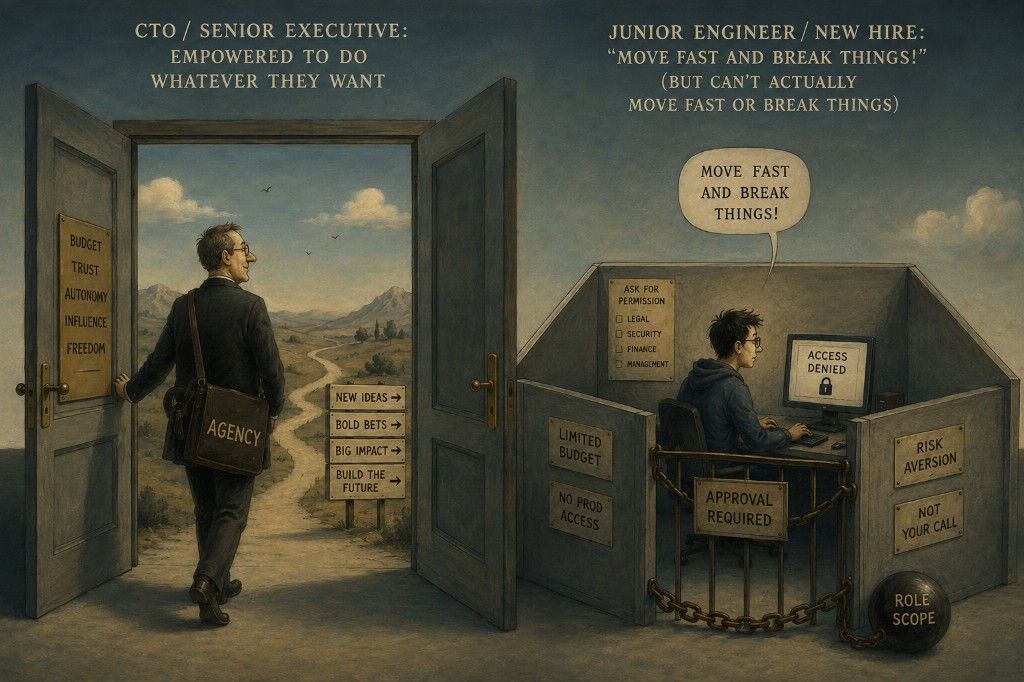
Give this some real thought right now. I bet you live in Lala Land. You believe that because you have access and because you have agency and because you take accountability that everyone in your business is like you.
Hear me now: You are the only CEO in the organisation. You are the only CMO, CTO, CPO, CFO, CBO, CRO or C-whatever-oh-whatever. Nobody else in the organisation has your access, your power, your control and your ability to move as fast as you and break things as easily as you.
You feel like everyone is moving slowly because over the past 20 years you, yes you, have implemented processed and procedures to proactively slow people down. You incentivise teams in a system that requires checks and balances and approvals from layers and layers of management before action can be taken and mistakes made.
The access gap is real and visceral for everyone in every organisation. If you want your people to move faster then you need to get the basics right and unlock the procedure handcuffs that prevent teams from actually taking accountability for the work they are doing.
THE HUMAN COST
Without foundational and fundamental changes to how we run businesses there is a very real and very immediate human cost to moving faster. I'm not arguing the moral cost here. I'm not entirely sure I buy into the idea that AI will arrive and destroy jobs indefinitely for swathes of human beings. That's a debate for a different article.
The human cost of moving faster and faster is more pragmatic, physiological and psychological. I'm seeing it, hell, I'm experiencing it every day.
When people are incentivised to use AI above all else then they do just that because the system (the boss) told them to and they lean the fuck in and product an unbelievable amount of absolutely useless rubbish.
From a psychological perspective there is a lot to consider here. If people use AI to do their work faster they instantly start to consider how long it will be before they are not needed at all to do the work. This is psychologically crushing for people who don't believe they have any agency within a system. They are trapped in an efficiency spiral that goes both up and down for them. The more efficient they become, they more they can get done, the better they look in the short term but over the long term they quietly believe (know) that they are working themselves out of a job because AI can do more and more. I don't believe this to be true because the smart businesses want to empower more of their best people to do bigger things more easily. That means keeping people is way better than letting people go.
But the other interesting thing happening is that people find themselves with a lot of spare time in work hours. Believe me or not, your teams are languishing for hours on end every week because they get their work done to your standards much faster than ever before.
The cascade of mental states that follows is called the Apathy Arch and it peaks with apathy and ends with an exit, or worse; smart people who don't leave but mentally check out.
Here's the Apathy Arch laid out:
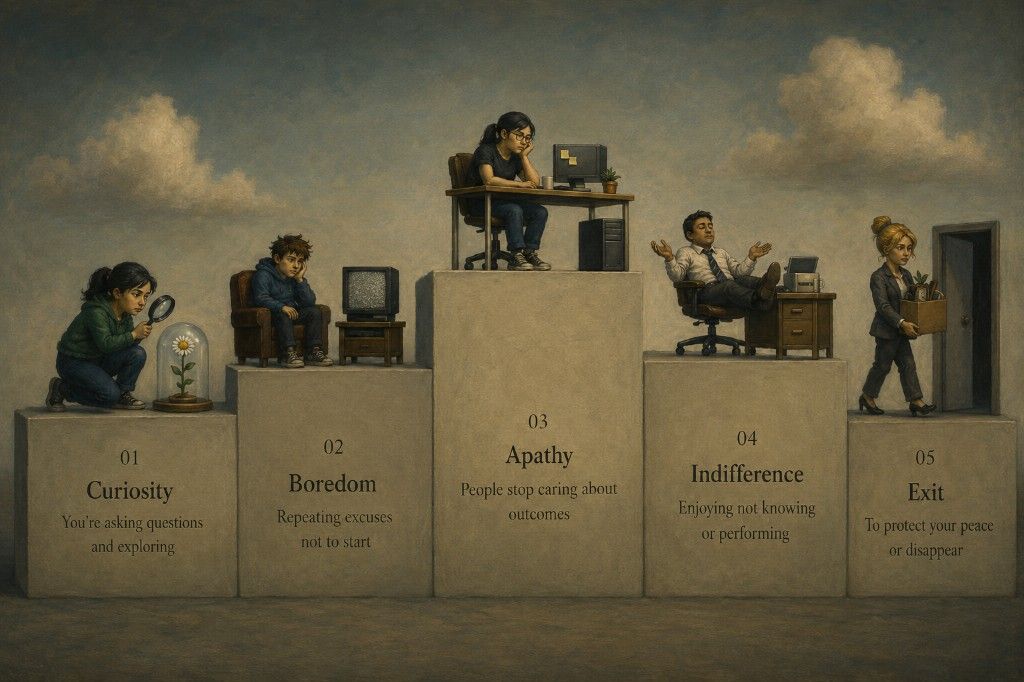
Explore the Apathy Arch in my latest keynote.
We're not short of research on this. What's striking is that studies from the Federal Reserve, Gallup, and ActivTrak, none of them connected, all arrived at the same uncomfortable conclusion. Disengagement risk rose to nearly 1 in 4 employees, up 21% in a single year. These aren't employees who are checked out. They're employees whose capacity isn't being used. Organisations have invested in reducing overload. Few have figured out how to actively leverage the capacity that freed up. And your highest AI adopters? They're saving up to half a workday every single week, and nobody's decided what they should do with it.
THE BLIND SPOT & THE MISDIRECT
Here's the misdirect that we're being told to believe: The faster you go the better the business will do and the more likely it becomes that you will keep your job. But that's not what I'm seeing out in the world. The faster we go, the worse the work becomes in most cases. The faster we go, the more obvious it becomes when a business hasn't nailed down the basics. We're being told that if we just get AI right, everything else will fall into place. I call bullshit.
What actually happens in the immediate short term is that AI ushers in chaos and chaos is not a good place to be when nobody really knows how AI is going to impact businesses long term.
If an organisation is moving too fast to get the basics right then the bottom is going to fall out. It doesn't matter how quickly you can ship products if your HR practices are terrible and people can't work together. It doesn't matter that you shipped 10x more code than last year if code reviews take 10x longer to get done. It doesn't matter if we're all moving fast and breaking things if the systems are actually breaking and nobody is trying to stabilise them. It doesn't matter how much AI you're using if the data input is absolute rubbish — shit in, shit out.
AI Adoption is the new vanity metric for businesses. It's a box to tick so the board leaves you alone. It's performance theatre that keeps leadership off your back. It's new, new, new at the cost of the customer's needs, needs, needs.
THE FIX
The single most frustrating thing to me right now is that the fix is so obvious.
SLOW THE FUCK DOWN.
Get the basics right, and if you don't know what "the basics" are then here are some for you to consider:
- Improved HR/People teams
- Better data access internally
- Fewer processes
- More customer conversations
- Authentic marketing and advertising
- Proper people management
- Considered change management
- Updated incentives to motivate teams
The basics.
It's so obvious to me that if you try to build an AI house on quick(fast)sand then the ground is going to swallow you up in a massive sink hole.
Slow down to speed up.
Focus on your customer.
Focus on your team and what they need and how to give them agency and freedom to build and explore with and for your business and each other.